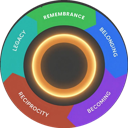
Ubuntu Roots Coaching™
Intellectual Property & Licensing
Clarity about what is ours — and what is not.
Last updated: September 2026 · Status: Pending legal review
Honesty about boundaries is a form of respect. This page explains what Maturity.Coach owns through Ubuntu Roots Coaching™, what we license, and — just as importantly — what we make no claim to. It complements our Terms of Use. If anything here is unclear, we invite you to ask; transparency is part of our covenant with you.
1. Ownership of the methodology
Ubuntu Roots Coaching™ is a proprietary coaching methodology of Maturity.Coach. This includes the framework's structure and terminology, the Living Tree Model, written materials, training curricula, assessment instruments, and associated program documentation, as developed and compiled by Maturity.Coach.
References to "Ubuntu Roots Coaching™" throughout this site denote this methodology and its materials — not any other entity, tradition, or body of knowledge.
2. What we do not claim: cultural traditions are not our property
This deserves its own section, stated plainly and without qualification:
Ownership of the Ubuntu Roots Coaching™ methodology does not imply ownership of, authority over, or representation of the cultural traditions, philosophies, and communities the framework references. These traditions are named as sources of inspiration and dialogue only.
The concept of Ubuntu — "a person is a person through other people" — originates from and belongs to the peoples and cultures of Southern Africa. It predates this framework by centuries. We did not create it, and we do not own it. Our methodology draws inspiration from this philosophy, but the philosophy itself remains the living heritage of its communities of origin.
Practically, this means:
- We claim no authority to speak for, license, or certify anyone's understanding or practice of these cultural traditions.
- We claim no right to restrict how communities of origin use, share, or teach their own heritage.
- Our trademark scope, if and when established, applies only to the specific commercial coaching methodology of Maturity.Coach — never to the cultural concepts themselves.
- Where our materials discuss cultural sources, they are offered with attribution and humility, intended as an invitation to dialogue, not appropriation.
We recognize the long history of extractive practices directed at African knowledge systems. Distinguishing between a proprietary professional methodology and the cultural heritage that inspires it is, for us, an ethical necessity — not a legal formality.
3. Trademark usage
Correct usage
- Refer to the methodology as Ubuntu Roots Coaching™ on first mention in formal materials.
- Use the name so it clearly refers to the Maturity.Coach methodology, not to the cultural philosophy generally.
- Maintain the ™ symbol in accordance with the usage guidelines to be published in the full notice.
Incorrect usage
- Using the mark to imply endorsement, certification, or affiliation without written authorization.
- Presenting the mark as ownership of, or authority over, the cultural traditions it references.
- Modifying, translating, or abbreviating the mark in ways that blur its meaning or scope.
- Registering domains, social handles, or business names confusingly similar to the mark for competing services.
A note on registration: Nothing on this page states or implies formal trademark registration in any jurisdiction. Trademark and ownership language throughout this site is subject to legal review before publication and may be revised as that review proceeds.
4. Permitted use
Subject to the full notice (below) and these terms, you may:
- Reference Ubuntu Roots Coaching™ by name in commentary, reviews, academic discussion, or journalism, with fair attribution.
- Quote brief passages of our published materials for criticism, scholarship, or review, consistent with fair use / fair dealing.
- Link to this site and share its public pages by direct URL.
- Discuss the cultural philosophies that inspire our work — freely and fully. Those traditions are not ours to gatekeep, and we do not attempt to.
Uses beyond these — including teaching, adapting, commercializing, or sublicensing the methodology or its materials — require a written license from Maturity.Coach.
5. Prohibited use
- Reproducing, distributing, or selling our proprietary materials without written permission.
- Delivering training or services branded as Ubuntu Roots Coaching™ without authorization.
- Representing oneself as certified, endorsed, or affiliated with Ubuntu Roots or Maturity.Coach absent a written agreement.
- Using the framework's name or materials in any manner that disparages or misrepresents the cultural traditions it references.
6. Licensing inquiries
We welcome conversations about licensing the Ubuntu Roots Coaching™ methodology — whether for organizational programs, educational partnerships, practitioner certification, or research collaborations.
Licensing & permissions
For commercial licenses, organizational use, and permission requests:
Partnerships & research
For research collaborations, see our Data Governance page for the ethical standards that guide such work.
When inquiring, please describe the intended use, audience, and scope. We respond to all serious inquiries and aim to make our terms clear and fair.
7. The full notice
The sections above are a plain-language summary. A full notice will address trademark usage guidelines, permitted use, and licensing terms in detail.
- In preparation — full trademark usage guidelines.
- In preparation — complete permitted-use terms.
- In preparation — licensing framework and contact routes.
- Required — legal review of all trademark and ownership language prior to publication.
Nothing on this page should be relied upon as legal advice or a final determination of rights. The notice, once reviewed and finalized, will govern.
Boundaries as respect
Some might see this page as housekeeping. We see it differently. Naming precisely what belongs to Maturity.Coach — a modern, professional methodology — and what belongs to communities we hold in respect — living cultural traditions — is itself an act consistent with the philosophy that inspires this work.
Intellectual property law protects what we built. It cannot, and should not, reach what was never ours.
Umuntu ngumuntu ngabantu — a person is a person through other people.
This page is a summary provided for transparency and does not constitute legal advice. Trademark and ownership language is subject to legal review before publication and may change. Nothing herein states or implies formal trademark registration in any jurisdiction. Consult qualified counsel regarding specific legal questions.