The primary metaphor
The Living Tree Model
Ubuntu Roots is visualized as a living, organic system. Select any element to explore its meaning, coaching purpose, reflective question, and relationship to the whole.
The model at a glance
Roots
Ancestral lineage and collective memory
- Meaning
- The unseen foundation: inherited values, gifts, stories, patterns, and unexamined assumptions that shape how a leader leads.
- Coaching purpose
- Invite reflection on what a leader has inherited — and what is theirs to carry forward, revise, or set down — without treating lineage as destiny.
- Reflective question
- What inherited values, gifts, stories, patterns, or unexamined assumptions shape your leadership?
- Practices
- Values-and-memory narrative; Reflection on inherited leadership patterns
- Relationship to the whole
- Feeds the Trunk and Branches; interpreted only in light of the Soil that surrounds it.
Read the full text version of the model
Context matters. Cultural, organizational, geographic, historical, and relational context must shape how every element of this model is interpreted. The model is adaptable, not prescriptive.
- Roots — Ancestral lineage and collective memory. The unseen foundation: inherited values, gifts, stories, patterns, and unexamined assumptions that shape how a leader leads. Reflective question: What inherited values, gifts, stories, patterns, or unexamined assumptions shape your leadership?
- Soil — Cultural and contextual ground. The particular conditions — cultural, organizational, geographic, historical, and systemic — in which a leader operates. Always particular, always present. Reflective question: What cultural, organizational, geographic, historical, and systemic conditions shape your choices and responsibilities?
- Trunk — The coaching relationship and container. The coach–client relationship: the agreements, trust conditions, boundaries, and practices that make developmental work possible. Stable and load-bearing. Reflective question: What are the agreements, trust conditions, boundaries, and practices that make developmental work possible?
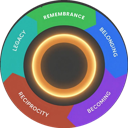
- Branches — The five dimensions of relational leadership. The five dimensions — Remembrance, Belonging, Becoming, Reciprocity, and Legacy — radiating outward from the trunk. One usually needs attention in a given season. Reflective question: Which dimension requires attention in this season of your leadership?
- Leaves — Tools, practices, and learning that emerge in season. The tools, practices, reflections, experiments, questions, and learning that emerge in context and change over time. Reflective question: What wants to grow in this season of your leadership?
- Canopy & Seed — Community, collective impact, and continuation. Leadership that shelters, supports, and nourishes those who come after — the shade a legacy casts, and the seeds being planted for the future. Reflective question: What shade does your legacy cast, and what seeds are being planted for the future?
Legend: the tree is read from the ground up — roots and soil below, a load-bearing trunk, five branches, seasonal leaves, and a canopy and seed above. Colour and position are supported by labels and text throughout; nothing depends on colour alone.
The six elements in depth
Roots
Ancestral lineage and collective memory — the unseen foundation of inherited values, gifts, stories, and assumptions that shape leadership.
Soil
The cultural and contextual ground — organizational, geographic, historical, and systemic conditions. Always particular, always present.
Trunk
The coaching relationship and container — the agreements, trust, boundaries, and consent that make developmental work possible.
Branches
The five dimensions of relational leadership, radiating from the trunk. One usually asks for attention in a given season.
Leaves
Tools, practices, reflections, and experiments that emerge in context and change over time.
Canopy & Seed
Community and collective impact — leadership that shelters those who come after, and the seeds planted for the future.
Questions for each layer
- Roots: What inherited values, gifts, stories, patterns, or unexamined assumptions shape your leadership?
- Soil: What cultural, organizational, geographic, historical, and systemic conditions shape your choices and responsibilities?
- Trunk: What are the agreements, trust conditions, boundaries, and practices that make developmental work possible?
- Branches: Which dimension requires attention in this season of your leadership?
- Leaves: What wants to grow in this season of your leadership?
- Canopy & Seed: What shade does your legacy cast, and what seeds are being planted for the future?
How a coach uses the model
The coach protects the trunk — clear agreements, confidentiality, and consent — and helps the client sense which branch needs tending, letting practices (the leaves) arise from the client's real situation rather than a fixed curriculum.
How a client experiences the model
The client leads. They decide what inherited material to explore, name the context they work in, choose the dimension that matters now, and define their own long-horizon intentions.
How organizations may use it responsibly
Illustratively: reflecting on institutional memory, context, and continuity — always adapted to context, with consent, and without implying required community participation or guaranteed outcomes.
Context matters. Cultural, organizational, geographic, historical, and relational context must shape how every element of this model is interpreted. The model is adaptable, not prescriptive.
Download the Ubuntu Roots Coaching™ Institutional Overview